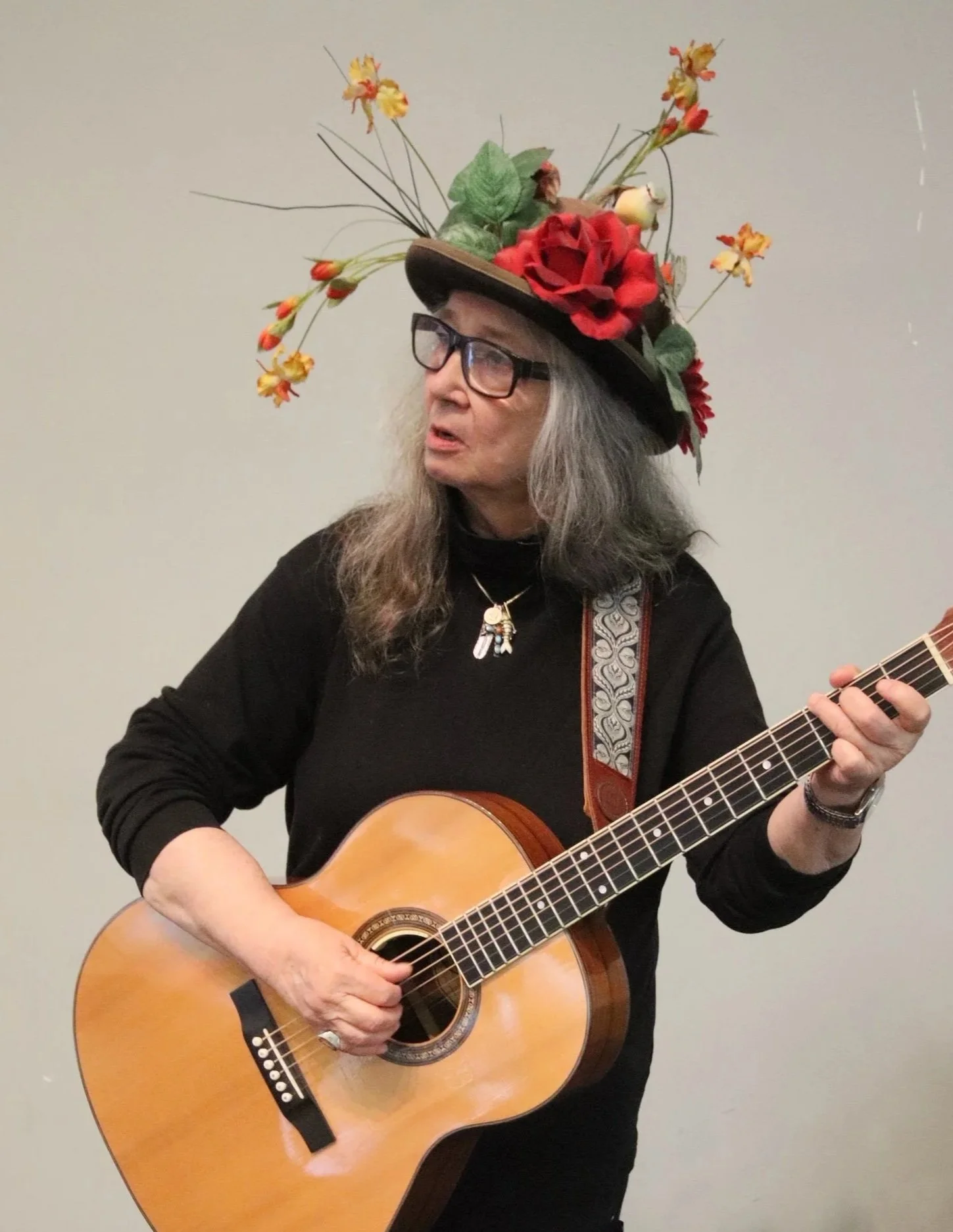
Biography
An Artist’s Journey for Truth and Justice: D.M. Lafortune
“My musical passion is turning pain into beauty. I use music to call people in and speak truth by making the unpalatable palatable by nestling it in music…this can spark a fire of awareness and bring about social change.”
“Art is dangerous. It is one of the attractions: when it ceases to be dangerous, you don’t want it.” – Duke Ellington
Toronto-based singer/songwriter/performing artist D.M. Lafortune started her musical journey as a young girl. But the roots of her art reach back to when she first entered the world.
Diem was born to a Cree Métis and Sami unwed mother, who was coerced into giving her up temporarily at seven-days old. She was to learn that her mother, Alice, visited her every day with her soon-to-be new husband. By the time she was seven-weeks old, they were settled and told the CCAS they were ready to take Diem back but the Catholic Children’s Aid Society told them that her baby had died. She was then illegally adopted by a couple with Scottish-Canadian and Acadian/Mi’kmaq heritage when she was seven months old. D.M.’s life has centered around a search for, and reclamation of, her identity. Her birth father was Jewish and a very good musician. She was terribly saddened to never have the opportunity to play music with him – his identity and information was denied to her by the provincial government even though her records were not, in fact, sealed.
Her music is a compelling tangle of love, joy, anger, and sadness. The songs dip, swoop and soar, combining folk, blues, and Celtic stylings. She calls it “Mosaic Music.”
Lost
D.M. did not know she was adopted. But she always felt as if she did not belong. The household where she grew up was not a warm one.
“I thought I was the evil twin of the second coming,” she recalls.
Her adoptive father, Joseph Amedee, was a railroad man and not home often. But for all his issues, D.M. now considers him a guardian angel. When he was home, she remembers many kitchen parties stoked by the Acadian music of his people.
“As a little girl I felt comfort standing in his shoes, dancing with him.”
Survival – Finding light with music
A love of classical music was born at an early age.
“On Saturday afternoons my friend Kathy and I would go to Massey Hall. We’d be allowed in to watch the Toronto Symphony rehearse. I’d take my shoes off and run up and down the aisles, like a wild horse, slowing down and speeding up with the music.”
Starting on the piano, she later switched to guitar.
“I wanted to be like Joan Baez. I remember hearing her sing ‘Be Not Too Hard’ when I was
11. It was such an emotional song and her voice had a sorrow I could relate to.”
Writing poetry was one of her first loves and Baez inspired D.M. to put her words to music.
She also found solace in her neighbourhood. Living near Yorkville when it was a music hub, she made friends with the owner of a graphic arts studio. The owner designed and printed album covers. His studio was also something of a rehearsal space and D.M., a 12-year-old teen at the time, met many of the day’s burgeoning musicians.
“I think they saw me as this precocious gifted kid and took me in. I was a dark-skinned ‘different’ kind of waif for that very white working-class part of Toronto.”
In high school, she made new musical friends and began hanging out at The Riverboat Coffeehouse. That’s where she met Neil Chapman, a guitarist she’s been playing with now for 50 years.
Her career first took hold in Toronto venues such as Fat Albert’s, The Free Times Café, and the Backyard Café alongside peers including Ron Sexsmith, Mose Scarlett, and Robert Priest.
Searching
After her adoptive mother and father died, she put her music career aside for a while and focused on becoming a lawyer. Social justice has always been a driver for D.M. But the real reason for the switch to the legal profession? She would do what no one else was willing to do – get her “supposedly sealed” birth records and find out who she really was. “If I became a lawyer I could do it for myself.”
She was called to the bar in 1996. Later, she launched a case against Ontario’s and the rest of the provinces adoption regimes, stating that sealed adoption orders violate children’s rights as stated in the United Nations Convention on the Rights of the Child. She also made strong arguments against the unilateral exemption from the federal criminal code, provinces granted adoptive parents in order to falsify birth records and erase her and other adopted people’s identities and severed all family connections. She lost the case.
Despite all that was going on she released a full-length CD, in from the cold, in 1999. It featured songs her trauma had channeled. The album received a warm response. Even though she wasn’t happy with the production, it received the Award for Perseverance in Music and Songwriting from the Maple Blues Society. But, the release of the CD did not make her deepest dream materialize.
“My mother did not come and find me.”
Even after years of therapy, she experienced a breakdown. She stopped performing and called in the CD. The experience, she says, was a breakthrough.
“It allowed the healing to begin.”
After a positive immersion in therapy (after years of negative ones), and support from some faith groups, she got back in the saddle. in from the cold was remixed and re-released under the title Beauty and Hard Times in 2012. It received rave reviews and three song videos were accepted for world premieres at the ImagineNative Film & Video Arts Festival.
By this time, after a lot of digging, she had learned who her birth mother was. She also learned her birth father was Jewish. Her mother had passed away before the two could meet. Although her father refused to acknowledge her, they did meet briefly and the anguish of not knowing who her parents were lessened.
Life picked up. She taught a course at a community college called From Social Analysis to Social Change for a couple of years. And ran a workshop called Decolonizing the Heart which dealt with these issues, aiming to find balance and harmony.
The Songwriting Process
How do D.M.’s songs get created? There are four ways.
“First, they come out fully or almost fully formed like a gift from the Creator and angels. I then tweak them.
“Second, I get an idea and there’s a little bit of the first thing happening… just flowing out like a gift but then I settle down and have a lot of work to do. These tend to require the most work.
“Third, something really moves me and I get a line. I write it down on anything I have handy. Then I make time and sit down at my kitchen table and sweat them out.
“Fourth, sometimes I’m trying to learn a cover and I end up riffing off of it and creating my own.”
Beauty and Hard Times: Some of the songs
“Ghostdance,” “Minuet for the Staircase Children,” “Where Are All the Children?” and “On the Evidence” are songs that embody the essence of D.M.’s story. Written when she was 18, they came out fully formed.
“Now that I know what happened to me, I’ve tweaked them more.”
“Minuet” addresses the experience of a child growing up in a family of broken dreams. The spindles on the stairs are like prison bars, as the child sits on the stairs listening to her parents’ drunken fights. The last lines of each chorus progress through the story of a little child dreaming of being old and leaving this awfulness behind.
“But it doesn’t happen that way. It did, however, help grow a scar over those wounds.”
Resolution
In 2018 a federal report came out vindicating D.M.’s struggles. It was called “The shame is ours: forced adoptions of the babies of unmarried mothers in post-war Canada,” by the Honorable Art Eggleton, Standing Senate Committee on Social Affairs, Science and Technology.
The report said it was the most inhumane act any Canadian government could have allowed to happen – the forced separation of newborns from their mothers because they weren’t married and therefore deemed unfit to keep their babies.
“The separation was constructed to be forever and irreversible. Not in anyone’s best interest since it caused mental anguish for adoptees like me.”
Truth to Power
“I want my art to be for adoptees and other people orphaned by circumstances beyond their control…what Angels in America did emotionally for people with AIDS. People of all stripes need to stop romanticizing adoption as a win/win when it’s a lose/lose situation.
I continue to break the silence with my music.”
Catharsis
The 25th anniversary of Beauty and Hard Times honors D.M.’s journey.
“Kindness, empathy, and understanding drive me. Music saved my life but I didn’t know and now it’s more than that. I have to honour this gift, save and share it. This is about resilience.”
Path Forward
D.M. has at least three albums in her that are ready to go.
“When I sing, I soar like an eagle, it makes me feel good. I have a new song I’ve just finished, “Mad Bastard’s Requiem and Resurrection Waltz.” It puts a lot of those previous themes together. One set of lyrics in particular speaks to the earlier songs. They kind of say: “This is why all that crap happened.”
What’s in a Name
When in from the cold was released, D.M. was known as Donna Marie Marchand. Reclaiming her identity years later, she legally changed her name to D. M. Lafortune, her birth mother’s last name. These days she’s simply known as D.M., Diem, or Mama D.
Achievements
Winning the Harry Hibbs Award for Perseverance from the Maple Blues Society.
Nomination for Aboriginal Songwriter of the Year by the Canadian Folk Music Awards in 2013.
Having the players of the caliber I have –List A session players, wanting to work with me. It’s a real honour.
Photography Grants Award Nomination I received numerous Canada Council grants as a photographer. Nominated for a Dora Award for photography and design for the Nightwood Theatre Production The Edge of the Earth is Too Near, Violette Leduc.
Theatre I love acting – I get to play people I’m not, by choice. She recently completed a 3-month tour with Theatre of the Beat’s production I Love You & It Hurts.
Teaching I am excited when I meet people who, like me, are into learning, sharing, and teaching. Teachers were my guardian angels.
Law Being called to the bar on Queen Victoria’s birthday. While losing my case was one of the cruelest and dumbest decisions a Canadian court has issued, having my work used as the foundation for a senate report was validating. That report led to a demand for an apology from the Canadian government and each of the provinces. I doubt we’ll see it in my lifetime, but the validation cracked my chest open for the first time!
– Maureen Littlejohn